
From graphic design to agentic workflows: the new standard for small business marketing
Agentic workflows let one person with good judgment do what used to take an agency, a developer, and a marketing hire. AI agents draft, build, and connect the routine work. The businesses that benefit are the ones where someone with taste designed the system first, deciding what good looks like before any agent writes a line.
For sixteen years my job was making things: logos, labels, websites, campaigns. The job now is building the system that makes them. That is not a demotion of craft. It is where craft went.
A small business used to need an agency, a developer, and a marketing hire to do what one person with good judgment and a set of AI agents can now do in a week. The tools are available to everyone. The difference between the businesses that benefit and the ones that produce a flood of forgettable content is whether someone with taste designed the system first.
What changed?
Three shifts, all in the last eighteen months.
Agents went from demos to tools. According to Techzine's coverage of Google I/O 2026 (opens in a new tab), Google Antigravity 2.0 is a standalone desktop application for directing AI agents, with parallel agents and a command-line tool, and Google brought it to its cloud platform for businesses, the Gemini Enterprise Agent Platform, which was previously called Vertex AI. Anthropic's Claude Code does comparable work from the terminal. The practical meaning: you describe an outcome, agents plan it, write it, test it, and show you the result.
Software became a marketing asset. When building is cheap, the best marketing move is often a tool, not a post. A booking engine that keeps the fee in your pocket. A site that answers the questions customers ask AI assistants. A report that writes itself.
Search split in two. Customers now ask assistants as well as Google. Being found means being readable by machines, which is a structural problem, not a copywriting one.
What does this mean for a local business?
It means you can punch above your size, if you pick the right fights. A few real examples from my own work:
- SB Boat Charters (opens in a new tab). A single-boat operator with a custom booking engine that replaced a commission-based platform. Guests book and pay on his site, and the money goes to his own account.
- Elite Advisor Hub (opens in a new tab). A full software platform for luxury travel advisors: branded sites, supplier catalogs, lead inbox, journal. Built by one person on Next.js, Supabase, and Vercel with AI-assisted development.
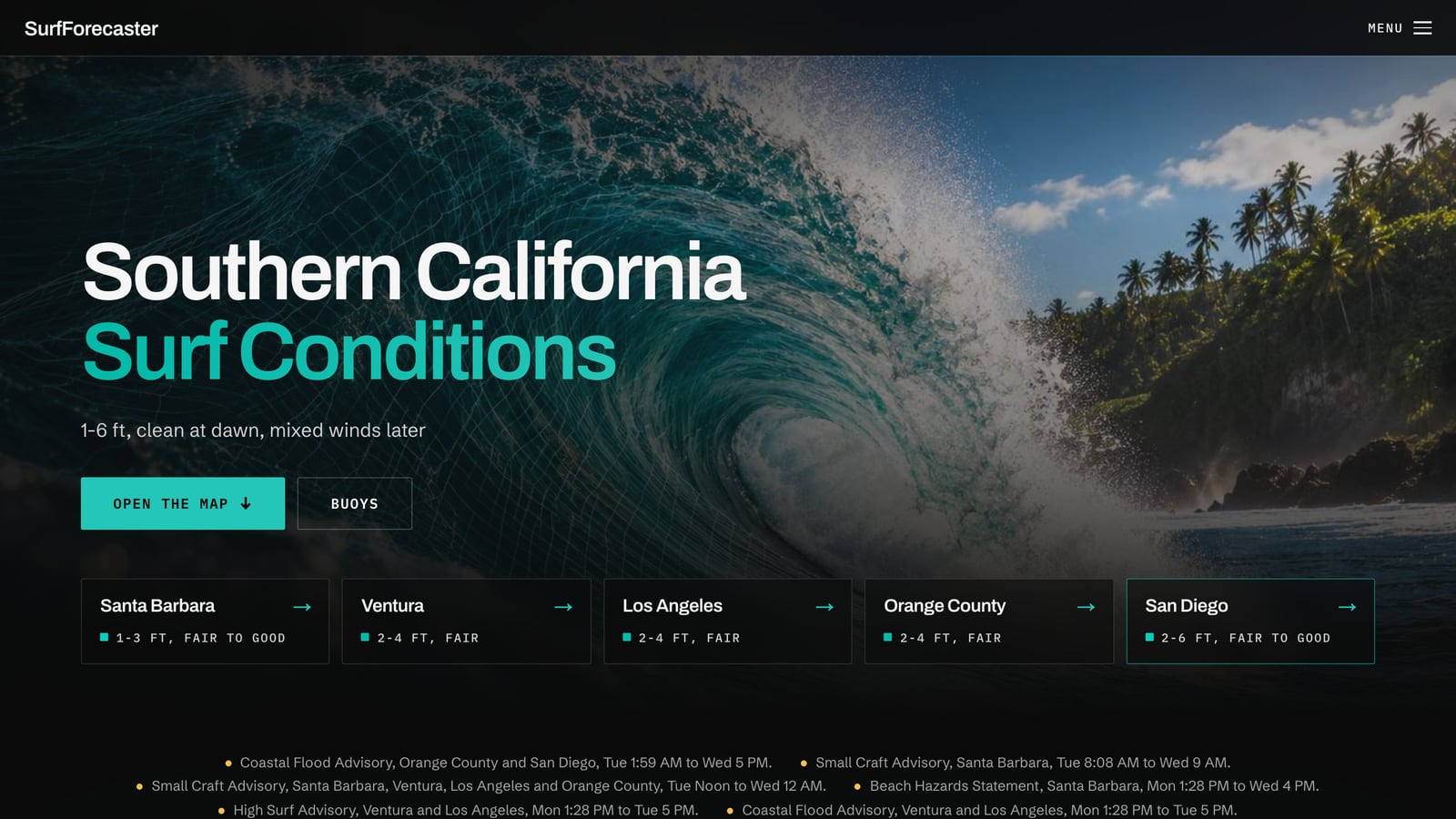
- SurfForecaster (opens in a new tab). Buoy and weather data turned into plain-language surf reports automatically.
- QCK Industries (opens in a new tab). A three-division service company (restoration, jobsite services, construction) presented as one clear site built for local search and fast estimates.
- Sunstone California (opens in a new tab). A Shopify brand for an estate winery and a functional beverage line, with packaging, store, and content sharing one system.
None of these required a ten-person team. All of them required someone deciding what good looks like before any agent wrote a line.
What is the new stack?
Think in five layers. This is the same model I described in A creative system beats a content calendar, applied to a whole business.
| Layer | What it is | Who owns it |
|---|---|---|
| Source material | Your real knowledge: customer questions, call notes, photos, pricing, reviews | You |
| Constraints | Positioning, voice rules, approved facts, legal limits | You |
| Production | Agents drafting copy, code, images, and variations | AI, supervised |
| Review | A standard with reasons to reject | You |
| Distribution | Site, email, social, listings, structured data | Automated |
Most businesses try to start at layer three. They open a chat window and ask for a post. The output is average because the input was nothing.
Which agentic workflows pay off first?
Pick ones that are repetitive, have a clear definition of done, and cross more than one system.
- Lead response. A form submission becomes a drafted reply, a CRM record, and a calendar suggestion in under a minute.
- Review handling. New reviews are summarized weekly with drafted responses in your voice and themes flagged for operations.
- Content from source. One customer question becomes a site FAQ entry, a short post, an email paragraph, and a Google Business Profile update.
- Reporting. Sales, traffic, and ad data pulled into one page with a plain-language summary every Monday.
- Site maintenance. Hours, menus, prices, and schema kept in sync across your site and listings.
- Small custom tools. An estimate calculator, a booking flow, a member portal. The category that used to be out of reach.
Run each one by hand three times before you automate it. If you can't describe the steps, an agent can't follow them.
Where does the designer go?
Up a level. When production is abundant, three things become scarce:
- Taste. Knowing which of forty options is right, and why.
- Positioning. Deciding what the business is not.
- Standards. Writing down the reasons to reject work so the system enforces them without you.
I call this creative engineering. The deliverable is no longer a campaign. It is the system that produces campaigns after I leave. Typography, hierarchy, and restraint still matter. They are now encoded as rules an agent follows and a reviewer checks.
What should you watch out for?
- Generic output. The symptom of a missing constraint layer.
- Invented facts. Agents state things confidently. Keep an approved-facts file and forbid anything outside it.
- Access and data. Agents that can act on your accounts need limited permissions and an audit trail.
- Platform dependence. Own your domain, your code, your customer list, and your payment account.
- Tool chasing. Names and features change monthly. The five layers don't.
A 90-day plan
- Days 1 to 30. Write the constraint layer: one paragraph of positioning, ten voice rules stated as prohibitions, a list of approved facts and proof. Pick one workflow and run it manually.
- Days 31 to 60. Automate that workflow with a human approval step. Fix your site's structure so machines can read your hours, prices, and services.
- Days 61 to 90. Add a second workflow. Scope one small custom tool that removes a fee or a bottleneck.
Where to start
List the five tasks you repeat every week that involve copying information from one place to another. That list is your agent roadmap. If you want help designing the system, or building the site and tools it runs on, I work with Santa Barbara businesses on web and custom software, automation and CRM, and AI visibility. Request a quote here.
Sources
Common questions
What is an agentic workflow in plain terms?
A task where AI handles several steps on its own (gathering information, drafting, checking, filing) and gives you a finished result to approve.
Do I need to know how to code?
Not to benefit. You need to describe outcomes and standards clearly. For custom tools, work with someone who can review what the agents build.
Is this only for tech companies?
No. The biggest gains are in ordinary local businesses with repetitive admin: hospitality, tours, trades, professional services.
Will AI make my marketing look like everyone else's?
Only without a constraint layer. Clear positioning, voice rules, and real source material are what make output yours.
Which tool should I pick?
Start with the one that connects to systems you already use. The workflow design transfers between tools. The tool names will keep changing.
Related posts
Why a creative system always beats a content calendar: one asset, every channel
How a modular marketing system turns one source asset into SEO, email, social, and AI visibility, and why the returns compound while posting resets.

A creative system beats a content calendar
Content calendars answer what to post. Creative systems answer how the work gets made. Only one of them survives contact with a busy quarter.