Every booking you take costs you 20 to 30 percent.And that number has no ceiling.
FareHarbor, Peek, and Bokun sit between you and your customer and take a cut of every trip, so your best season is also your most expensive one. I build charter operators their own site with the booking engine inside it. The site is free. What I charge is $149 a month plus 1.5 percent of completed trips, and it stops at $599 no matter how much you book.
The math, both sides of it
commonly the combined cut on a booking platform once the platform fee and card processing are both counted, and it scales with every dollar you book
CaptainBook, FareHarbor Pricing and Fees Explained, 2026typical monthly booking platform subscription, charged before any per-booking fee is added on top
CaptainBook pricing, 2026the most I can bill you in a month, at any volume. At $75,000 in monthly bookings that works out to under 1 percent
The fee is the visible cost. The real one is that the platform owns the customer, the reviews, and the data, and rents them back to you every season.
What operators actually deal with
I built the booking platform for a Santa Barbara charter operator. These came up in every conversation before the rebuild.
- 01
The commission compounds
It scales with you and it has no cap. A good season costs you more than a bad one, and you never negotiate the rate.
- 02
You build the site anyway
The platform gives you a widget. You still have to find a template, wire it up, and keep it looking right. You are doing the work and paying the fee.
- 03
The customer is theirs, not yours
Booking confirmations, review requests, and rebooking prompts go out under the platform's name. Your repeat business gets built on someone else's list.
- 04
Pricing you cannot control
Fees get added at checkout after your customer has already decided. Junk-fee rules are tightening state by state, and California already requires the advertised price to be the price they pay. Widgets make that hard wherever you operate.
- 05
Nobody runs the season from the software
Blackout days, phone bookings, gift cards, turnaround time between trips. Most operators end up keeping a paper calendar next to the dashboard.
Leaving a platform is easier than operators think
The two real risks are losing your existing forward bookings and losing search traffic on the URLs the platform ranked for. Both are solvable in a normal build. Existing reservations get imported, old URLs get redirected, and I keep the platform live in parallel until the new engine has taken real bookings. You do not switch on faith.
The Charter Booking Engine
A custom site with the booking engine built into it. The build is free across a 12-month term. After that you pay a flat base plus a small percentage of trips you actually ran, and the whole thing stops at $599 a month.
The Build
Fixed scope. Your site, your booking engine, your Stripe account. Designed and built by me, delivered finished, with nothing due at signing.
- Full custom website designed around your operation, not a booking template
- Live availability engine: schedule rules, blackout dates, turnaround buffers, double-booking blocked at the database
- Stripe Connect checkout so fares land in your account and you issue your own refunds
- All-in advertised pricing, so the number on the listing is the number charged
- Gift cards, issued and redeemed on your own site
- Admin portal: upcoming departures, manual phone bookings, blackout days, gift card balances
- Automated booking confirmations and reminders sent under your name
- Migration of forward bookings and redirects from your current platform
The build is worth $2,500 and it is waived over your first 12 months. Cancel before month 12 and the waived build fee comes due, prorated. Stay past it and it is gone for good.
The Engine
Hosting, support, seasonal changes, and the booking engine itself. The percentage is there so a slow winter costs you almost nothing. The cap is there so a strong summer does not get punished.
- $149 a month base, plus 1.5 percent of completed trips, capped at $599 total
- The 1.5 percent bills on trips that actually ran. Cancellations and refunds never generate a fee
- Absorb the 1.5 percent or build it into your listed prices. Your call, switchable per account
- Hosting, SSL, backups, and uptime monitoring
- Pricing, schedule, and charter-type updates as your season changes
- Stripe and dependency maintenance so checkout never quietly breaks
- Support when something goes wrong on a Saturday
- A short monthly read on bookings and where they came from
The cap engages at $30,000 in monthly bookings. Every dollar past that is free. Pay annually and you get two months back. Card processing, roughly 2.9 percent plus 30 cents, goes to Stripe and is separate.
Add-ons priced per project: art-directed photography for your charter listings, an Instagram feed on the site, a YouTube gallery, or a connection to whatever else you already run. The booking page converts on the images more than the copy, and most operators are selling a $2,000 charter with a phone photo.
You do not build any of this
That is the part the platforms will not do. FareHarbor and Bokun hand you a widget and a settings panel and leave the website to you. I hand you a finished site. There is no template to pick, no page builder to learn, no design decisions to make at eleven at night in the off season. You send me photos, pricing, and your schedule rules. You review it twice. Then it goes live.
The live build
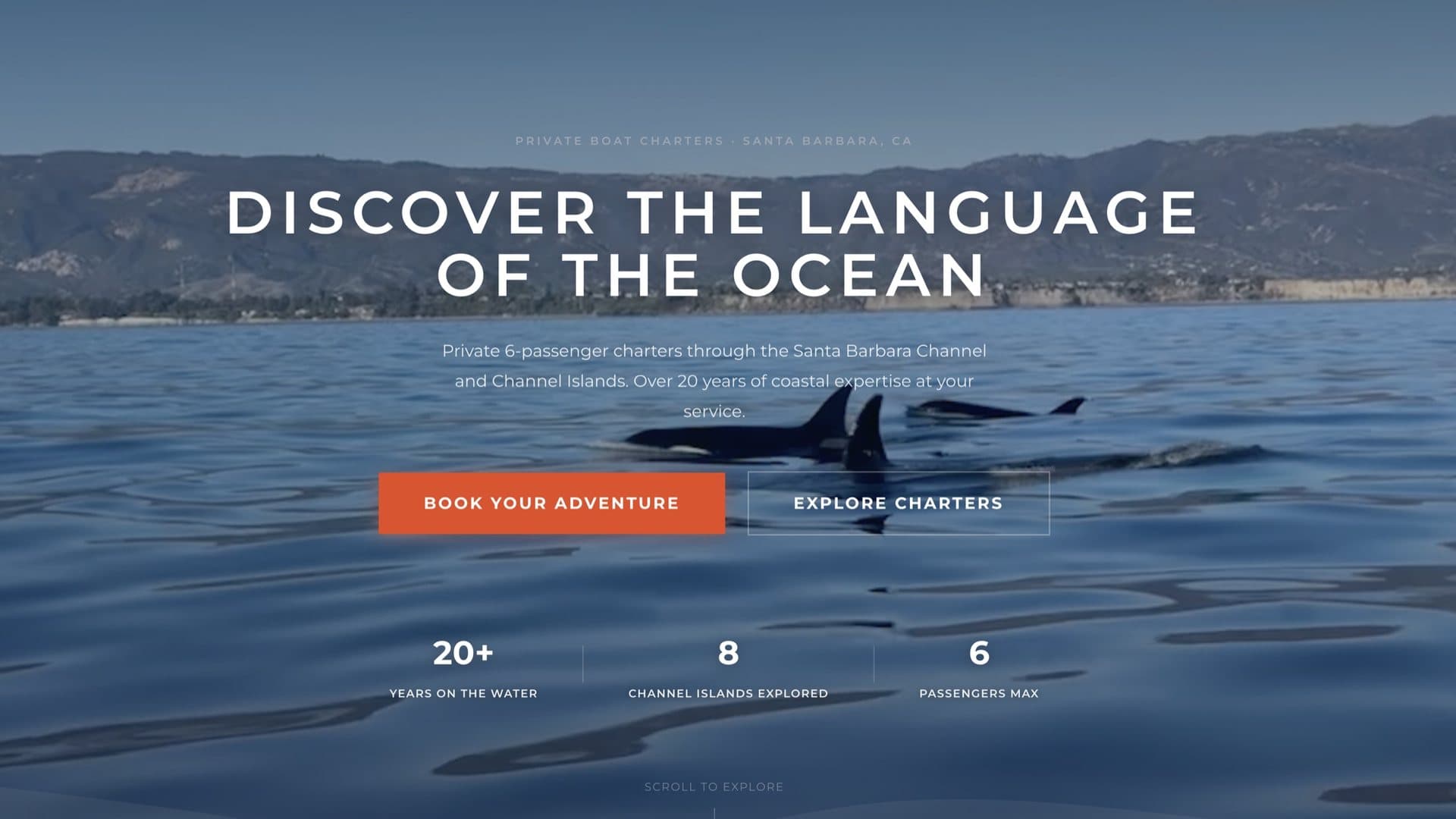
SB Boat Charters runs on this exact system. Live availability across every charter they offer, Stripe checkout, gift cards, and an admin portal the captain runs the season from.
How it works
- 01
Free fee audit
Send me your booking platform and roughly what you did in bookings last season. Within 3 business days I will tell you what the platform actually cost you and what this would have cost instead, month by month.
- 02
15-minute call
If the number lands, we talk scope and dates. No deck, no discovery phase billed by the hour.
- 03
The build
Three to four weeks, nothing due at signing. Site, booking engine, payments, admin portal. You review twice: mid-build and before launch.
- 04
Parallel launch
The new engine goes live while your old platform is still running. Once it has taken real bookings and you are comfortable, you cancel the platform. Billing starts at launch, not at kickoff.
Questions operators ask
The website is really free?
Yes, across a 12-month term. The build is worth $2,500 and I waive it because I would rather you say yes and stay than write a check and hope. If you cancel before month 12 the waived fee comes due, prorated by the months you did not use. That is the only catch and it is the whole catch.
So what do I actually pay every month?
$149 base, plus 1.5 percent of the trips that actually ran, and the total never goes above $599. At $10,000 in monthly bookings that is $299. At $30,000 it is $599. At $75,000 it is still $599. Card processing goes to Stripe and is separate, around 2.9 percent plus 30 cents.
Do I pay the 1.5 percent on a cancellation?
No. The percentage bills on completed trips only. If a customer cancels or you refund them, no fee is generated on that booking. A platform commission usually is not that forgiving.
Can I pass the 1.5 percent to the customer?
You can, and it is a setting on your account rather than a support ticket. If you turn it on, it gets built into the price your customer sees rather than tacked on at the end, which keeps you clear of the all-in pricing rules now spreading state by state. Most operators leave it absorbed. At 1.5 percent it is quieter than a price increase.
How is this better than a 20 percent commission?
It stops. A platform takes its cut on every dollar forever, so growing your business raises their invoice too. Mine has a ceiling at $599. By about $1,500 a month in bookings this is already the cheaper option, and it keeps getting cheaper the better you do.
Do you only work with California operators?
No. I am based in Santa Barbara and the first build was here, but this is software and the work is remote. I build for charter operators anywhere in the US: Florida, the Gulf, the Carolinas, the Chesapeake, the Great Lakes, the Pacific Northwest, Hawaii, Alaska, New England. The whole process is a form, a call, and two review rounds. Nobody needs to be on the same dock.
What happens to bookings already on my platform?
They get imported before launch, so your calendar is accurate on day one. Anything booked on the old platform during the parallel period gets brought over too.
Who owns the site?
You do. Your domain, your Stripe account, your customer list. If you stop working with me after the term, the site keeps running and I hand over everything.
How much do I have to build or configure myself?
None of it. That is the difference between this and a booking platform. You send photos, pricing, and your schedule rules. I do the rest and it arrives finished.
What if I run more than one boat?
Multi-vessel works and it does not change the pricing. Availability is computed per vessel with its own schedule rules and turnaround buffer. Tell me the fleet size in the audit so I can scope the build.
Can I still list on Viator or GetYourGuide?
Yes, and you probably should. Those are real demand channels. The goal is not to have zero OTA bookings, it is to stop paying a commission on the direct bookings you already earned.
Who actually does the work?
I do. No juniors, no handoffs. I take on a few builds at a time, which is why the timeline is honest and the work stays good.
Get your free fee audit
Send me your booking platform and roughly what you booked last season. Within 3 business days you get a written breakdown of what the platform actually costs you, what this would cost instead at your volume, and where the line crosses. No call required, no obligation.