
Why your charter booking engine is losing bookings at checkout
Most charter operators have a checkout problem, not a traffic problem. Guests pick a trip and a date, then leave at payment because a fee appears late, the calendar fights them on a phone, or checkout looks like a different company. A custom booking engine on your own site, paying into your own account, removes those leaks.
Most charter operators think they have a traffic problem. Usually they have a checkout problem. People find the boat, like the photos, pick a date, and then leave at the payment step. The cause is rarely the price of the trip. It is a fee that appears late, a calendar that fights back on a phone, or a checkout page that suddenly looks like a different company.
Travel has some of the highest abandonment rates of any online purchase. You can't remove all of it, because people comparison shop. You can remove the part your software causes.
How bad is booking abandonment in travel?
PhocusWire's summary of SaleCycle data (opens in a new tab) put travel abandonment at 81.31 percent against a 76.9 percent average across sectors, and noted that of all visitors to travel sites, 17.6 percent begin a booking and only 3.1 percent finish one. Those figures are a few years old, but more recent operator-side estimates land in the same 70 to 82 percent range, and higher for tours and activities.
The part you control is the reason people give. In SaleCycle's survey on abandonment reasons (opens in a new tab), 53 percent of shoppers who abandoned did so when shown the total price. Travel sites are known for adding extras at the last step. A booking fee line is exactly that.
Where do charter bookings actually leak?
1. A fee that shows up at the end. Many booking platforms add a per-booking fee to the guest's total at checkout. On a $1,200 private charter, a 6 percent fee is $72 the guest didn't expect. Some pay it. Some leave to think about it and never come back.
2. A calendar built for a desktop. Tiny date cells, slots that don't match the trip length, and a guest counter that lets someone select eight people for a six-passenger boat. Every error message is an exit.
3. Checkout that changes brands. The guest clicks Book and lands on a page with a different logo, different fonts, and a different URL. For a four-figure purchase, that reads as risk.
4. Forced account creation. Nobody wants a password for a sunset cruise.
5. A slow widget. Embedded booking tools load third-party scripts, often in an iframe. On a dock with two bars of signal, the calendar spins.
6. Dead ends. The date is full and the page says "unavailable." No next-best date, no waitlist, no phone number.
7. No recovery. The guest leaves and nothing happens. No saved cart, no follow-up email, no way to finish later.
What is each leak worth?
Here is a simple model. Swap in your own numbers.
| Input | Example |
|---|---|
| Monthly visitors who start a booking | 200 |
| Completion rate today | 20% (40 bookings) |
| Average booking value | $900 |
| Monthly booking revenue | $36,000 |
| Completion rate after fixing friction | 25% (50 bookings) |
| Added monthly revenue | $9,000 |
A five-point lift in completion is not exotic. It is what removing a surprise fee and a broken mobile calendar can do. And that is before counting the platform fees themselves.
Why does a custom engine convert better?
Because it removes the leaks at the source.
- One all-in price from the first screen. No fee line. The price on the trip page is the price at checkout.
- Payments go to your own account. Guests pay on your site through a processor like Stripe, and deposits land in your bank on your payout schedule. You are not waiting on a platform's remittance or sharing the customer record.
- Rules that match the boat. Passenger caps, trip durations, departure windows, and blackout dates enforced by the software, so nobody books something you can't deliver.
- One brand from photo to receipt. Same domain, same design, confirmation from your own email address.
- Real pages search engines can read. Trip descriptions, prices, and availability live in your own HTML with structured data, which helps both Google and AI assistants recommend you.
- You own the guest list. Rebooking, reviews, gift cards, and referrals run on your data.
What does this look like on a live site?
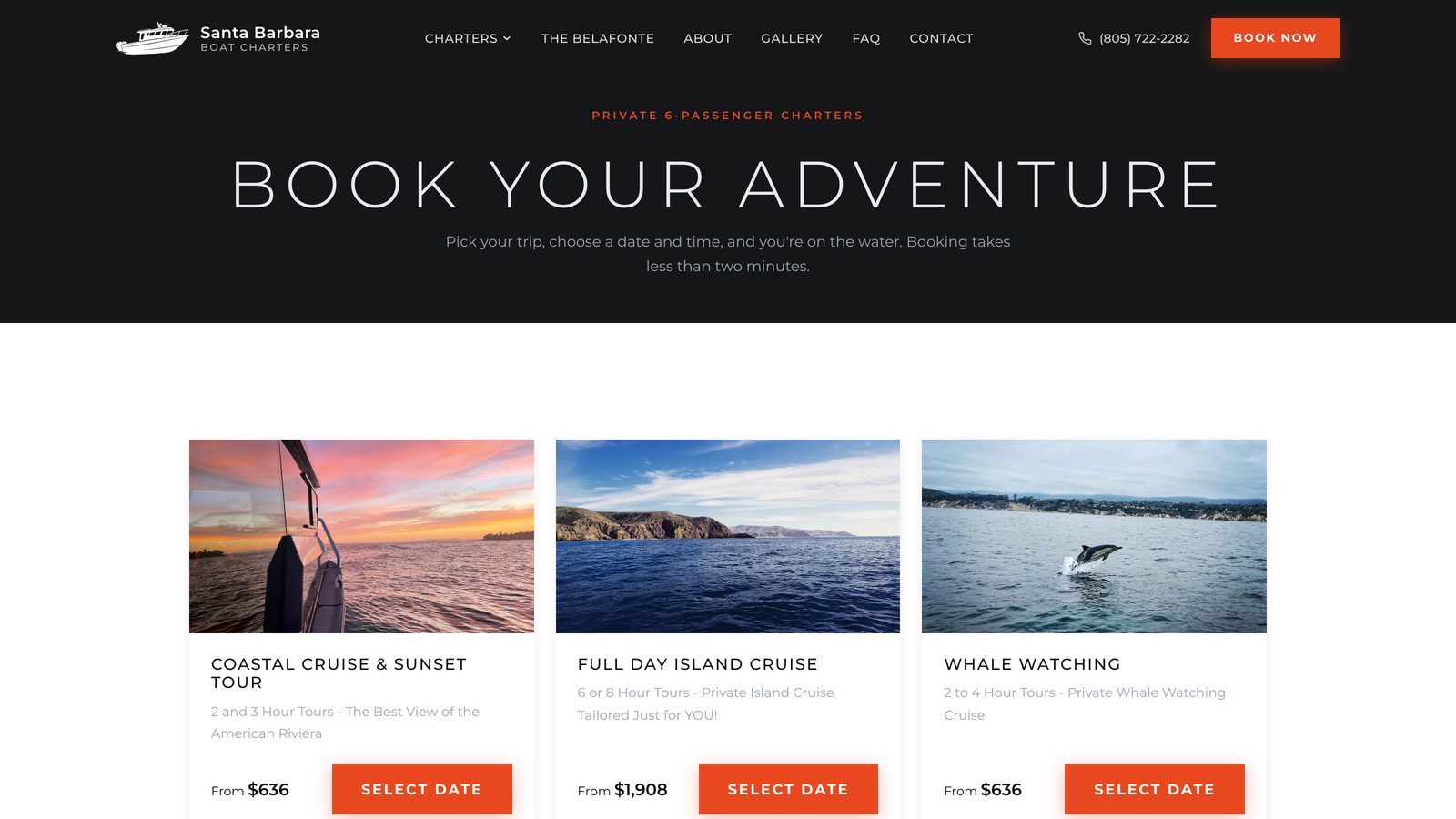
I built the brand, website, and booking engine for SB Boat Charters (opens in a new tab) in Santa Barbara. It replaced FareHarbor in July 2026. A few choices that speak directly to the leaks above:
- The site states that prices shown include all booking fees. Nothing new appears at payment.
- Each trip type (Channel Islands tours, whale watching, sunset cruises, lobster diving) has its own page, pricing, and slots.
- Capacity matches the vessel. The boat carries six, so the counter stops at six.
- Gift cards are sold and redeemed on the same site.
- A custom-trip request path exists for guests who don't fit a preset, so a full calendar is never a dead end.
- Payments go to the operator's own Stripe account.
You can read how the build works on the Charter Booking Engine page.
Should you keep the marketplaces?
Yes, for discovery. Viator, GetYourGuide, and FishingBooker put you in front of people who have never heard of you. Their commission is the price of that introduction. The mistake is paying marketplace or platform economics on guests who already found you by name, by referral from a hotel concierge, or by walking past your slip.
Keep one calendar as the source of truth so you never double-book across channels.
What should you measure first?
- Start rate. Of visitors to a trip page, how many open the booking flow?
- Completion rate. Of those, how many pay?
- Mobile vs. desktop completion. A large gap means the mobile flow is the problem.
- Total fees per booking. What you pay plus what your guest pays.
If you don't have these, your current platform's reporting and Google Analytics can produce them in an afternoon.
Where to start
Book your own trip on your phone, on cellular, as a stranger would. Note every moment you hesitate. Then pull last season's fee totals. Those two exercises tell you whether you need a tune-up or a different engine.
I offer a free fee and friction audit for charter and tour operators. I will walk through your checkout, total your platform fees, and show you what a custom booking engine would change. Book a demo here.
Sources
Common questions
What is a good booking conversion rate for a charter?
It depends on price and traffic source, so benchmark against yourself. Track completion rate monthly and aim to improve it by removing one friction point at a time.
Do booking fees really cause abandonment?
Unexpected costs at checkout are one of the most cited reasons people abandon travel purchases. A fee line that appears at the last step is an unexpected cost.
Can payments go straight to my bank account?
Yes. With a custom engine connected to your own Stripe account, guest payments are deposited to you directly on Stripe's payout schedule.
How long does a switch take?
A focused charter site with integrated booking typically takes three to four weeks, including moving existing reservations and redirecting old links.
Does this work for tours that are not on boats?
Yes. Wine tours, kayak and e-bike rentals, surf lessons, and private experiences have the same needs: time slots, capacity limits, blackout dates, and a guest list you own.
Related posts

Editorial web design for boutique luxury hotels and travel brands: moving beyond template sites
Why restrained, editorial web design wins high-ticket bookings for boutique hotels and travel brands, and the choices that move guests to book direct.
How independent luxury travel advisors can use AI to scale client communication without losing the personal touch
Where agentic AI helps independent luxury travel advisors with inquiries and itinerary drafts, where a human stays in the loop, and how to set it up.